If you’ve ever worked with high-power electronics—whether in industrial equipment, medical devices, or renewable energy systems—you’ve probably needed components that can handle extreme voltage without failing. As a high voltage diode supplier, I get dozens of emails every week from engineers, maintenance technicians, and even product designers asking a specific question: what exactly is a high voltage diode module, and why can’t I just use a stack of individual diodes instead? Today, I’m breaking this down in plain, practical terms, no overly complicated jargon, because I’ve seen firsthand how confusion about these parts leads to wasted time, failed projects, and even safety risks on the shop floor. High Voltage Diode
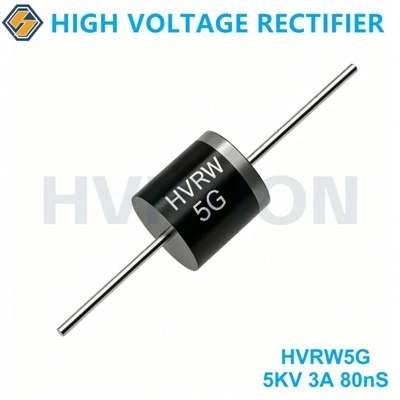
Let’s start with the basics: a single diode is a simple semiconductor device that lets current flow in one direction and blocks it in the other. That’s the core function, right? But when you’re working with voltages above 1,000 volts—say, the 50,000 volts used in X-ray machines, the 10,000 volts needed for some wind turbine converters, or the thousands of volts in industrial laser systems—individual diodes hit a wall. For one thing, a standard small-signal diode rated for 1,000 volts won’t just fail when pushed over that limit; it can short out completely, creating a dangerous arc that damages other equipment and puts people at risk. For another, high voltage applications often need consistent, reliable performance over thousands of operating hours, and individual diodes are hard to mount, wire, and troubleshoot without introducing human error.
That’s where the high voltage diode module comes in. At its core, a high voltage diode module is a pre-assembled, integrated unit made up of multiple individual diodes (or sometimes a combination of diodes and other supporting components) enclosed in a single, rugged package. The most common design is a series string of diodes connected end-to-end to build up the voltage rating, but modules also include built-in voltage balancing resistors or capacitors to make sure every diode in the string shares the load evenly. Wait, that’s a key point I want to emphasize: series diodes don’t automatically split voltage evenly. If one diode is slightly weaker or has a small manufacturing variation, it will get more voltage than the others, leading to early failure. A good high voltage diode module is engineered to eliminate that problem, so every part works in sync for the life of the module.
Let’s put this in context with a real example from my work. Last year, I worked with a team at a mid-sized medical device company that was designing a new portable X-ray unit. They initially tried using 10 individual 5 kV diodes stacked in a string, thinking that would get them to 50 kV, their required operating voltage. But after two weeks of testing, half their prototypes failed. When they sent the failed diodes back, we saw that two diodes in each string had burned out from excess voltage—because they didn’t have balancing components. We recommended switching to our standard 50 kV high voltage diode module, which has 11 diodes (with a small safety margin) and built-in ceramic voltage balancing resistors. Since they made that switch, they haven’t had a single module failure in their production units, and their testing time dropped by 15% because they no longer have to calibrate individual diodes. That’s the difference a purpose-built module makes, versus cobbling together individual parts.
Now, you might be wondering: what are the key features that set a high voltage diode module apart from a random collection of diodes? Let’s go over the ones we prioritize in every module we manufacture, because they’re non-negotiable for high voltage applications. First, voltage rating. Modules are rated for continuous reverse voltage (the voltage they block) and forward voltage (the voltage they allow when conducting). For most industrial and medical uses, we offer modules from 1 kV up to 150 kV, but we also custom-build higher voltage units for specialized applications like particle accelerators or high-power laser systems. Second, current rating. This is the amount of current the module can safely carry while conducting. A X-ray module might need 100 mA, while a wind turbine converter module could need 100 A. We match the current rating to the specific application, because running a module at too high a current will overheat it and shorten its life. Third, insulation and packaging. High voltage modules need to be enclosed in materials that can hold up to that voltage without arcing—usually high-grade epoxy, ceramic, or molded plastic that’s tested for dielectric strength. We use ceramic for modules that need to operate at extreme temperatures, because epoxy can crack or degrade if exposed to heat or vibration over time. Fourth, thermal management. High voltage diodes generate heat when they conduct, so good modules include integrated heat sinks or mounting tabs that let you attach them to a heatsink or chassis to dissipate heat. A module without proper thermal management will overheat, even if you’re operating it within its voltage and current limits.
Another common question I get: what are high voltage diode modules used for? The list is longer than you might think. Medical is a big one: X-ray and CT scanners rely on high voltage diodes to generate the high voltage needed to produce images. Industrial applications: laser cutting and welding equipment, electrostatic precipitators for air pollution control, and power conversion systems for wind and solar energy. Transportation: some electric vehicle fast chargers use high voltage diodes to convert AC power to DC at the levels needed to charge a car in under 30 minutes. Even scientific equipment, like particle accelerators and mass spectrometers, use custom high voltage diode modules to handle the extreme voltages required for their work.
I’ve seen a lot of engineers try to cut costs by going with cheaper, unbranded high voltage diode modules, and while that might seem like a good idea at first, it almost always leads to bigger problems down the line. Last year, a client called us in a panic: their entire factory’s electrostatic precipitators had failed, costing them $200,000 in lost production in just three days. They had bought cheap modules from a overseas supplier that weren’t properly tested, and over time, the diodes inside the modules were breaking down from the constant high voltage, leading to arcs that burned out the entire unit. When they tested our standard modules against the cheap ones, ours had a mean time between failures (MTBF) of over 1 million hours, while the cheap ones had an MTBF of less than 10,000 hours. That’s not a difference—it’s a gap. For applications where downtime means lost revenue or safety risks, a reliable high voltage diode module isn’t an expense—it’s an investment.
So, how do you choose the right high voltage diode module for your project? Let’s walk through the steps I take with every client, because getting this wrong can derail even the best design. First, figure out your required operating voltage. Don’t just go for exactly what you need—add a 10-20% safety margin. If your application needs 50 kV, a 55 kV or 60 kV module will give you room to handle voltage spikes, which happen in almost every power system. Second, calculate your maximum forward current. This is the current the diode will carry when it’s conducting. You can find this in your application’s design specs, and if you’re not sure, we can help you calculate it. Third, think about your operating environment. If you’re working in a hot factory floor, a marine environment with high humidity, or a mobile application like an electric vehicle, you’ll need a module with a temperature rating and packaging that’s designed for that. Fourth, consider your mounting and space constraints. Some modules are designed for through-hole mounting on a PCB, while others have large mounting tabs for attaching to external heat sinks. We can build modules in custom sizes too, if your project has unique space requirements.
Wait, I also want to talk about a common misconception: high voltage diode modules are only for large, heavy-duty applications. That’s not true. We recently worked with a startup that’s designing a portable blood analyzer, which uses a small X-ray source to test blood samples. They needed a high voltage diode module that was small enough to fit in a handheld device, and could operate at low power. We built a custom 20 kV module that’s less than half the size of a standard industrial module, uses minimal power, and has been tested to last for 10,000 operating hours—more than enough for their product’s lifespan. That’s the thing about high voltage diode modules: they’re customizable, so there’s a solution for almost any application, no matter how big or small.

As a high voltage diode supplier, I’ve spent 12 years working with these components, and the biggest mistake I see is people treating high voltage diodes as generic parts. They’re not. The semiconductor materials, the way the diodes are connected, the balancing components, the packaging—all of these details matter when you’re dealing with voltages that can kill a person or destroy a piece of equipment worth millions. A good high voltage diode module is engineered for consistency, reliability, and safety, and that’s not something you can cut corners on.
High Voltage Rectifier Bridge If you’re working on a project that uses high voltage, whether you’re designing a new medical device, upgrading a renewable energy system, or troubleshooting an industrial machine, and you’re not sure which high voltage diode module is right for you, I’m here to help. We offer free technical consultations, no sales pitch, no pressure—just honest advice based on our years of experience. We can help you calculate voltage ratings, current requirements, and even build custom modules if your project needs something off the beaten path. Don’t waste time testing cheap parts or cobbling together individual diodes—get a reliable module that will keep your project running smoothly. Reach out to us to discuss your high voltage diode module needs and find the perfect solution for your application.
References
- Semiconductor Diode Module Design Guidelines, International Electrotechnical Commission (IEC) 60747-5
- High Voltage Semiconductor Device Application Handbook, Texas Instruments, 2022
- Reliability of Series-Connected Diode Strings for High Voltage Applications, Journal of Power Electronics, Vol. 18, No. 3, 2018
- Medical Device High Voltage Component Standards, Association for the Advancement of Medical Instrumentation (AAMI) STM 5081
Anshan HVRTION Electronic Technology Co., Ltd.
As one of the most professional high voltage diode manufacturers and suppliers in China, we’re featured by quality products and good price. Please rest assured to buy discount high voltage diode for sale here and get quotation from our factory. We also accept customized orders.
Address: 17 East Jiefang RD., Tiedong District, Anshan, Liaoning, China.
E-mail: hvrtion@hotmail.com
WebSite: https://www.hvrtion.com/
