If you’ve ever walked into a commercial building, a school, or a multi-unit apartment complex and noticed ceiling panels that stand out for their ability to slow the spread of fire long enough for people to evacuate, you might have wondered: how do those panels get that property? As a gypsum board ceiling machine supplier who’s spent over a decade designing and maintaining the equipment used to produce these panels, I get that question all the time, and the short answer is yes—our machines absolutely make fire-resistant ceiling boards. But it’s not just flipping a switch or adding a random chemical; it’s a precise, standardized process that balances chemistry, engineering, and building code requirements, and I’m breaking it down here today to clear up the confusion. Gypsum Board Ceiling Machine

First, let’s start with the basics so we’re all on the same page. Gypsum, the core material for ceiling boards, is calcium sulfate dihydrate (CaSO₄·2H₂O), which means it’s bound to two molecules of water. When you apply heat, that water turns to steam and evaporates—this is why regular gypsum board is naturally somewhat fire-resistant, but not enough for commercial or high-stakes spaces. A standard ½-inch gypsum board will char when exposed to flames, but it takes about 15 to 20 minutes for the core to break down enough to fail. For hospitals, office towers, or apartment buildings, that’s often not enough; fire codes require panels that can hold their structural integrity and resist flame spread for 60, 90, or even 120 minutes, depending on the space. That’s where the modifications to the gypsum mix, and the machines that produce it, come in.
I’ve had customers show up to our factory convinced that fire-resistant gypsum boards are just regular boards with extra fire retardant slathered on the surface. That’s a common misconception, and one that can lead to failed inspections if done wrong. The actual fire-resistant formula is tailored into the core of the board during production, and our ceiling board machines are built to handle that modified mix without disrupting the quality of the panel. Let’s walk through the production process step by step, because that’s where the difference happens.
The first step in any gypsum ceiling board line is preparing the core mix. For standard boards, the mix is mostly calcined gypsum (plaster), water, and small amounts of additives like paper pulp for strength or mold inhibitors. For fire-resistant boards, we adjust this mix to include two key components: expanded vermiculite and chemically treated glass fibers. Expanded vermiculite is a lightweight, heat-absorbent mineral that traps water, slowing down the evaporation rate when heat hits the board. Chemically treated glass fibers add structural rigidity, so when the gypsum starts to break down, the board doesn’t crumble immediately— this is critical for meeting ASTM E119 standards, the most widely used fire test for building materials. Our machines have precision dosing systems that measure these additives to within a fraction of a percentage point; too little vermiculite, and fire performance drops; too much, and the board becomes brittle, prone to cracking during installation. That’s the part of the process that only works with the right equipment— you can’t pour this mix by hand and get consistent results every time.
Next, the mixed slurry is deposited onto a continuous sheet of backing paper, which is then topped with another layer of face paper. This is where machine design becomes non-negotiable for fire-resistant boards. The line has to maintain a uniform thickness—even a 1/32-inch gap in thickness can create a weak spot where heat penetrates faster. Our machines use calibrated rollers that apply even pressure across the entire width of the board, and laser sensors that check thickness every two seconds to adjust automatically. For standard boards, a small thickness inconsistency might not be noticeable, but for fire-rated panels, that inconsistency can mean the difference between passing a 60-minute fire test and failing it. I’ve had a customer come to me two years ago because a batch of their fire-resistant boards failed inspection, and when we checked their old machine, we found the rollers were worn unevenly, creating thin spots that led to faster charring. Upgrading to our precision roller system fixed their issue immediately.
After forming, the board moves through a long curing oven. This is where the gypsum rehydrates and sets, and here too, fire-resistant boards have specific temperature requirements. Standard boards cure at a consistent 140°F to evaporate excess water, but fire-resistant boards need a slower, more gradual heating process to keep the vermiculite and glass fibers evenly distributed. Our ovens have multiple temperature zones that can be adjusted in 5°F increments, so producers can fine-tune the curing profile. If you heat too fast, the water in the vermiculite evaporates too quickly, leaving gaps in the core that let heat pass through. If you heat too slow, the board takes too long to set, leading to production delays and higher costs. Over my 12 years as a supplier, I’ve worked with producers to adjust oven settings for different climates and desired fire ratings—for example, installations in coastal areas with high humidity need slightly longer curing times to ensure the fire-resistant additives are fully bonded.
Once cured, the boards go through a trimming and quality control phase. This is another step that our machines optimize for fire-resistant boards, because even small imperfections can compromise performance. Our trimming saws have diamond blades that cut clean, straight edges without chipping the core, which is important because fire-rated panels need tight seams when installed. Loose edges or chipped corners can create gaps that allow smoke and flame to spread between panels. We also build our machines to produce boards with consistent weight per square foot, a metric that’s directly tied to fire performance. Fire-resistant boards are slightly heavier than standard ones, but only if the mix is correct—our machines track mix weight throughout production to eliminate underfilled or overfilled panels that would fail fire tests.
Now, you might be wondering: are there cases where our ceiling board machines don’t produce fire-resistant boards? Absolutely—standard ceiling boards, moisture-resistant boards for bathrooms or basements, mold-resistant boards for hospitals. The machines are versatile, which is why we design them with quick-change settings, so producers can switch between standard and fire-resistant runs without fully reconfiguring the line. That flexibility is important for small to mid-sized producers who don’t need a dedicated fire board line. But when a producer uses our machines with the correct mix and adjusted settings, the resulting boards meet or exceed international fire safety standards, including ASTM E119, UL 263, and Euroclass B-s1, d0, the European standard for fire performance.
I’ve seen too many producers cut corners on fire-resistant board production, usually to save money, and it always comes back to hurt them. Last year, I met with a small commercial contractor who had installed fire-rated ceilings in a 12-unit apartment complex, only to have the local fire marshal reject them. They’d tried adding a cheap spray-on fire retardant to standard boards, instead of using our machine’s mixed core formula, and the spray peeled off during construction, leaving the panels unprotected. That’s not a failure of the machine—it’s a failure of understanding how fire-resistant boards are made. The machine is a tool that ensures consistency, but the mix and settings are what make a board fire-resistant.
Another common question I get: is there a difference between fire-resistant boards and fire-rated boards? For practical purposes, yes, though the terms are often used interchangeably. “Fire-resistant” refers to the inherent property of the board’s core, while “fire-rated” means the board has been tested and certified to meet specific performance criteria. Our machines produce boards that, when paired with the certified mix and proper installation, become fire-rated. We work closely with testing labs to help our customers adjust their production lines to meet new standards, so when a new code comes out for high-rise buildings, our machines are already updated to accommodate the required changes.
I also want to address a myth that I see online sometimes: that all gypsum board machines are the same, and that any producer can make fire-resistant boards with any equipment. That’s just not true. A machine that’s built for high-volume, standard board production might not have the precision dosing, thickness control, or oven zoning needed for consistent fire-resistant panels. I’ve tested used machines from other suppliers that can’t maintain the required mix ratios, leading to batches of fire boards with unpredictable performance. Our machines are engineered from the ground up to handle the unique demands of fire-resistant gypsum, which is why so many large contractors and building material suppliers partner with us for their fire-rated board lines.
Let’s talk about why this matters beyond just building codes. Fire safety isn’t a technicality—it’s a matter of saving lives. When a fire breaks out in a school or a hospital, every minute counts. A fire-resistant ceiling panel can slow the spread of flame long enough for evacuations, giving firefighters more time to contain the blaze, and reducing property damage. As a supplier, I don’t just sell machines—I sell the equipment that helps build safer spaces. That’s why we invest so much in R&D, testing our machine designs to ensure they can produce fire boards that perform as promised, even in extreme conditions.
If you’re a producer considering adding fire-resistant ceiling boards to your product line, or if you’re having issues with your current line producing inconsistent fire boards, I’d encourage you to reach out. We offer on-site assessments of existing lines to see if they can be adjusted for fire production, or we can build a custom line tailored to your volume and desired fire ratings. We don’t do one-size-fits-all here, because we know every customer’s needs are different—whether you’re supplying small residential projects or large commercial developments.
At the end of the day, the answer to “Does a gypsum board ceiling machine make fire-resistant ceiling boards?” is a resounding yes—but only when the machine is designed to handle the specific mix, precision, and curing requirements that fire performance demands. It’s not a simple process, but it’s a critical one, and the right equipment makes all the difference in producing panels that meet safety standards and keep people protected.
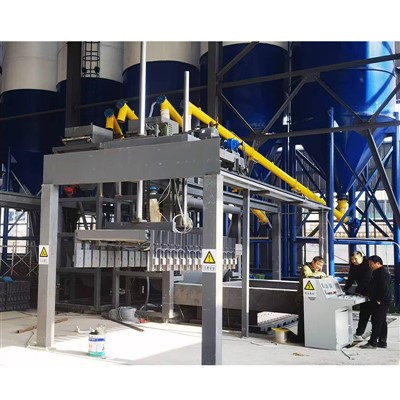
If you’re ready to upgrade your line to produce consistent, code-compliant fire-resistant ceiling boards, or if you have questions about how our machines can fit your production needs, feel free to reach out to our team to discuss your project in detail. We’d be happy to share case studies, production specs, and guidance on meeting fire safety standards for your region.
Desulfurization Gypsum Powder Production Line References
ASTM E119-23, Standard Test Methods for Fire Tests of Building Construction and Materials. American Society for Testing and Materials, 2023.
UL 263, Standard for Fire Tests of Building Construction and Materials. Underwriters Laboratories, 2021.
International Building Code (IBC) Section 717, Fire Resistance-Rated Construction. International Code Council, 2024.
Shineye Mach Co., Ltd.
Shineye Mach Co., Ltd. is one of the most reliable manufacturers and suppliers of gypsum board ceiling machine in China, also supports customized service with reasonable price. Please feel free to buy advanced gypsum board ceiling machine made in China here from our factory. For quotation, contact us now.
Address: Jinzhou Circular Industry Park, Jinzhou City, Shijiazhuang City, Hebei Province, China
E-mail: xiangyijixielucia@yeah.net
WebSite: https://www.shineyemach.com/
